Most CRM lists for contractors are written by people who have never invoiced a job. They rank generic sales software by feature count and leave you to figure out that a contractor CRM has one real test: does a lead from your website or phone end up as a signed agreement, a scheduled crew, and a paid invoice without you retyping anything along the way.
The short answer: The best CRM for contractors depends on your trade. For service contractors who want lead capture through signed contract and payment in one price, HoundBell from $57 per month. For field service with dispatch, Jobber. For roofing and exteriors, JobNimbus. For builders and remodelers running long projects, Buildertrend.
I have set contractors up on most of this list through my agency work since 2017, and I build one of the tools on it. Seven picks, published pricing where it exists, and who should skip each.
The 7 best contractor CRMs, compared
| Tool | Price | Best for | The catch |
|---|---|---|---|
| 1. HoundBell | From $57/mocontracts, e-sign, and invoicing included | Service contractors: lead to signed job to payment | No Gantt-style project management or GPS |
| 2. Jobber | $49 to $199/mo+$29/mo per extra user | Field service crews with dispatch | Per-user fees; texting on the top plan |
| 3. JobNimbus | Quote-based | Roofing and exteriors | Pricing behind a sales call |
| 4. Buildertrend | Paid plans | Builders and remodelers | Project tool first; heavy for service work |
| 5. Builder Prime | Paid plans | Home improvement sales pipelines | Narrower than the all-in-ones |
| 6. Housecall Pro | $79 to $329/mopipeline and several features are paid add-ons | Home service dispatch | Add-on pricing stacks |
| 7. FieldPulse | Quote-based | Small crews that bid on margin | Pricing not public |
1. HoundBell: lead to signed contract to paid
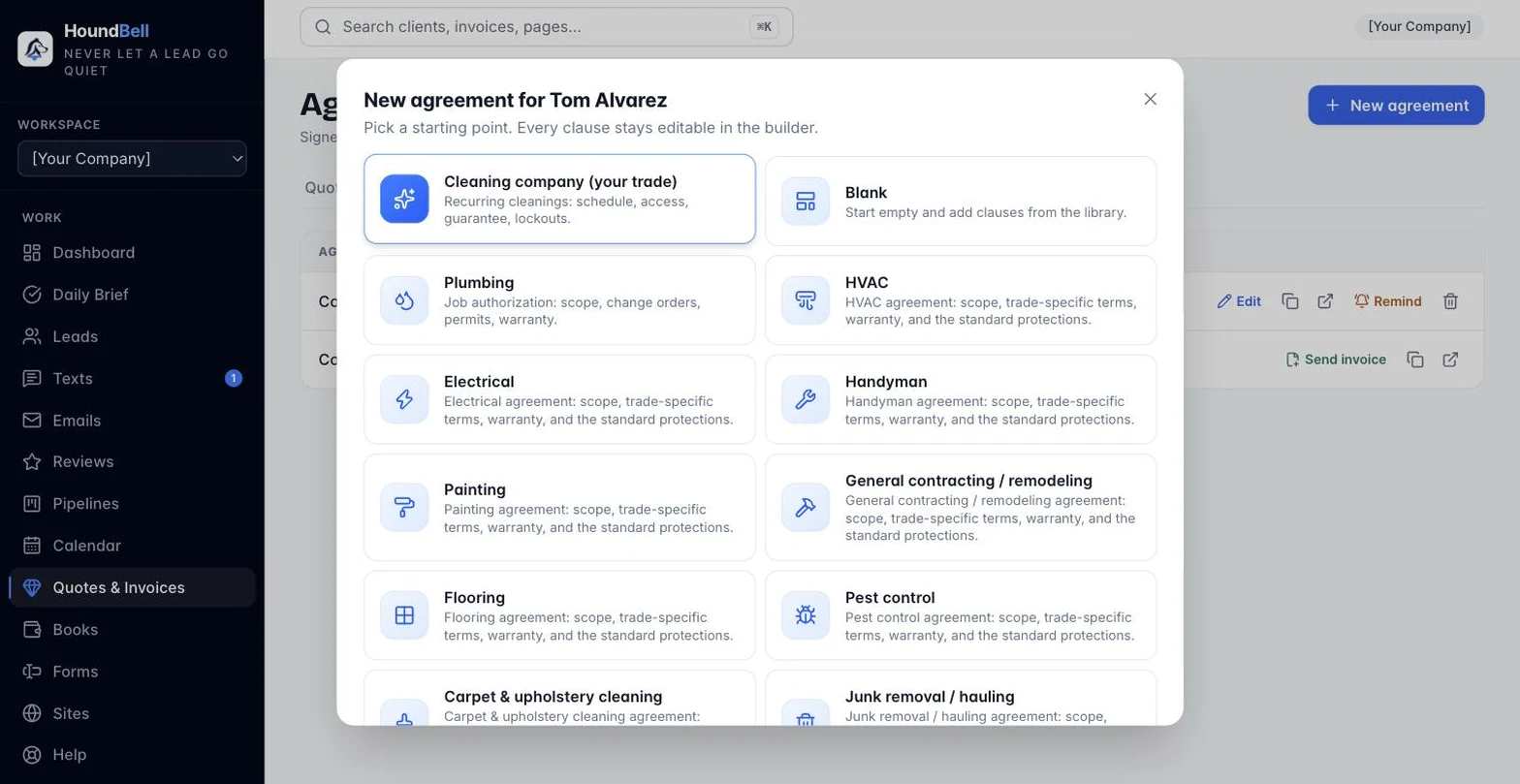
HoundBell is my product, so weigh this entry accordingly. It is built for the contractor whose jobs are sold, not managed: you quote, the client signs, a crew shows up, the invoice gets paid. Pick your trade at signup and the pipeline, website form, booking services, and a starting agreement for that trade are already there. The agreement piece matters more for contractors than anyone: a clause library, e-signature with a full audit trail, and the signed terms pulled verbatim into the invoice.
- From $57 per month ($47 founding, locked for life), nothing metered, 14-day free trial without a card
- Growth at $127 includes 10 full users plus unlimited free field-crew logins: crews see their jobs, directions, and a Done button, never your money
- Crew job photos: Before and After shots from the tech’s phone land on the booking and the client card
- Quotes with automatic day-3 and day-7 follow-ups, invoices with card payment, recurring invoices with autopay
- Automatic review requests after the job closes the loop that fills next month’s pipeline
The honest limits: no Gantt-style project management, no GPS. Job costing came off this list in September 2026; it now ships with Scale’s Insights, so you can see what each job really made after labor and materials. A remodeler running twelve-week projects should look at Buildertrend below. A service contractor selling and scheduling jobs should click through the live demo and see the path end to end. Full feature list here.
2. Jobber: field service with dispatch
Jobber is the most polished general field-service tool: scheduling, dispatch, quoting, and a deep app marketplace, from $49 for one user to $199 for ten, each extra seat $29. It earns its reputation. Watch the same two lines every Jobber buyer learns: per-user pricing compounds as you hire, and two-way texting sits on the $199 Grow plan. I keep a full HoundBell vs. Jobber comparison and a Jobber alternatives guide for the details.
3. JobNimbus: the roofing standard
For roofing and exterior contractors, JobNimbus is the incumbent for a reason: boards built around insurance and retail roofing workflows, photo documentation, material integrations, and a mobile app crews actually use. Pricing is quote-based. If you roof, it belongs on your shortlist.
4. Buildertrend: for builders and remodelers
Buildertrend is a construction project management platform with CRM attached: selections, schedules, budgets, client portals, and change orders for jobs measured in weeks or months. If your work is projects, it is the serious choice. If your work is service calls, it is a lot of software between you and an invoice.
5. Builder Prime: home improvement sales
Builder Prime focuses on the sales half of home improvement: lead tracking, estimating with price books, proposals, and commission math. Companies running canvassers and closers get the most from it. It is narrower than the all-in-ones, which is both the appeal and the limit.
6. Housecall Pro: dispatch with add-ons
Housecall Pro runs $79 for one user to $329 for eight, with a strong dispatch board and consumer financing. The pipeline and several other features are paid add-ons, so price the plan you would actually assemble, not the sticker. My Housecall Pro alternatives guide covers the escape routes, and HoundBell vs. Housecall Pro the head-to-head.
7. FieldPulse: for margin-watchers
FieldPulse is a small-crew field service tool whose standout is job costing: knowing what the job actually made you after labor and materials. User satisfaction scores run high. Pricing is quote-based, so budget a call.
How to choose
Name your work. Projects that run weeks: Buildertrend. Roofs: JobNimbus. Trucks to dispatch daily: Jobber. Jobs you sell, sign, schedule, and invoice: HoundBell, from $57 per month with contracts and e-signature included. Then price your real headcount on each, add-ons and per-user fees included, before you commit. New to the category? Start with what a contractor CRM actually does.
Sell the job. Sign it. Get paid.
Pick your trade and HoundBell builds the pipeline, form, and contract to match. Free for 14 days, no card required.
Start freePrices are from each vendor’s public pricing page in September 2026, monthly billing, and can change. HoundBell is not affiliated with the companies mentioned; trademarks belong to their owners.

Michael Barros
Founder of HoundBell and of Business All In One Marketing Solutions, a digital marketing agency serving local businesses since 2017. Michael writes about lead capture, follow-up systems, and the software local service businesses run on. More about Michael